
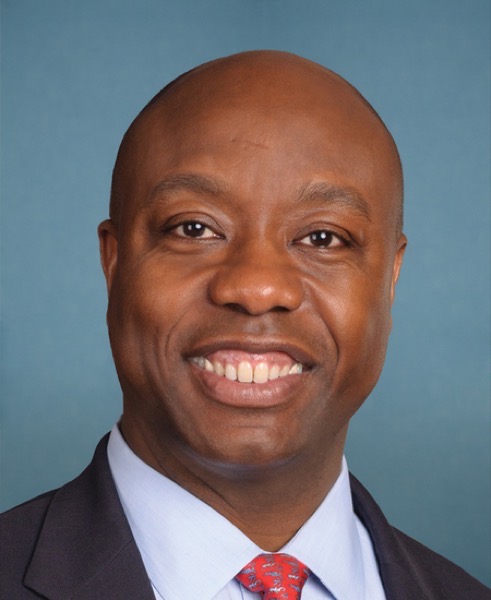
Jewish Voter Guide
Tim Scott
U.S. Senate · SC · Republican
Summary
Timothy Scott was born in 1965 and is currently serving as the junior United States Senator from South Carolina. Senator Scott’s seat will be up for election in 2028. Senator Scott ran unsuccessfully for the Republican nomination for U.S. President in 2024.
Scott was first appointed to the U.S. Senate to represent South Carolina by then-Governor Nikki Haley to replace retiring Jim DeMint. Scott won a special election in 2014 and was elected to a full term in 2016. Previously, he represented the 1st Congressional District of South Carolina in the U.S. House of Representatives from 2011 until 2013. In his political career, Scott has also served in the South Carolina General Assembly and on the Charleston County council.
Senator Scott is currently serving on the Finance Committee; the Health, Education, Labor and Pensions (HELP) Committee; the Banking, Housing, and Urban Affairs Committee; the Small Business and Entrepreneurship Committee; and the Special Committee on Aging.
Below is Senator Scott’s voting record and public positions on issues important to the Jewish community.
Senator Scott opposed the Iran nuclear deal. He supported the move of the U.S. embassy to Jerusalem. He supported the Taylor Force Act, which states that no American governmental funds shall be given to a Palestinian entity that financially rewards terrorists or their families. He also criticized the UN Security Council Resolution 2334, which claimed that Israel’s settlements have no legal validity, and cosponsored legislation that objected the resolution.
In 2018, Senator Scott cosponsored the United States-Israel Security Assistance Authorization Act, a legislation that supported full funding of security assistance to Israel as outlined in the 2016 U.S.-Israel Memorandum of Understanding. Senator Scott opposes the Boycott, Divestment, and Sanctions (BDS) movement and cosponsored the Israel Anti-Boycott Act and the Combating BDS Act of 2017, two bills that aim to fight discriminatory boycotts that target Israel.
In 2019, he voted for the Strengthening America’s Middle East Security Act which, among other things, strengthened Israel’s security and allowed a state or local government to adopt measures to divest its assets from entities that boycott Israel.
He introduced the Anti-Semitism Awareness Act of 2019, which aims to provide for the consideration of a definition of anti-Semitism for the enforcement of Federal antidiscrimination laws concerning education programs or activities.
Positions
Per-issue alignment with the American Jewish Congress’s positions. Every claim links to its source. No aggregate score or grade.
Combatting Antisemitism
Antisemitism Awareness Act
AlignedSupports the Anti Semitism Awareness Act
Introduced the Anti-Semitism Awareness Act of 2019
U.S.–Israel Relationship
Two-state solution
AlignedSupports the Two State Solution
Opposed UN Security Council Resolution 2334 and supported the two-state solutionUN Security Council Resolution 2334
OpposedOpposed UN Security Council Resolution 2334
Opposed UN Security Council Resolution 2334 and supported the two-state solutionStrengthening America's Middle East Security Act (2019)
AlignedVoted For the Strengthening America's Middle East Security Act of 2019
Voted For the Strengthening America’s Middle East Security Act of 2019U.S.-Israel Security Assistance Authorization Act (2018)
AlignedSupported the United States Israel Security Assistance Authorization Act of 2018
Cosponsored the United States-Israel Security Assistance Authorization Act of 2018Iran nuclear deal (JCPOA)
OpposedOpposed the Iran Deal
Opposed the Iran nuclear dealU.S. embassy in Jerusalem
AlignedSupported the U.S. Embassy Move to Jerusalem
Supported the move of the U.S. embassy to JerusalemTaylor Force Act
AlignedSupported the Taylor Force Act
Supported the Taylor Force Act
BDS & Anti-Israel Sentiment
Anti-BDS measures
AlignedOpposes BDS
Cosponsored the Israel Anti-Boycott ActIsrael Anti-Boycott Act
AlignedSupported the Israel Anti Boycott Act
Cosponsored the Israel Anti-Boycott ActCombating BDS Act of 2017
AlignedSupported the Combating BDS Act of 2017
Cosponsored the Combating BDS Act of 2017
Sources
- Opposed the Iran nuclear deal https://twitter.com/SenatorTimScott/status/621099232204824576
- Voted For the Strengthening America’s Middle East Security Act of 2019 https://www.senate.gov/legislative/LIS/roll_call_lists/roll_call_vote_cfm.cfm?congress=116&session=1&vote=00016
- Introduced the Anti-Semitism Awareness Act of 2019 https://www.congress.gov/bill/116th-congress/senate-bill/852/cosponsors
- Cosponsored the Israel Anti-Boycott Act https://www.congress.gov/bill/115th-congress/senate-bill/720/cosponsors
- Supported the move of the U.S. embassy to Jerusalem https://www.whitehouse.gov/briefings-statements/support-president-trumps-decision-recognize-jerusalem-israels-capital/
- Opposed UN Security Council Resolution 2334 and supported the two-state solution https://www.congress.gov/bill/115th-congress/senate-resolution/6/cosponsors
- Supported the Taylor Force Act https://www.congress.gov/bill/115th-congress/senate-bill/1697/cosponsors
- Cosponsored the Combating BDS Act of 2017 https://www.congress.gov/bill/115th-congress/senate-bill/170/cosponsors
- Cosponsored the United States-Israel Security Assistance Authorization Act of 2018 https://www.congress.gov/bill/115th-congress/senate-bill/2497/cosponsors
- Cosponsored Senate Resolution 120 that opposes the global BDS movement https://www.congress.gov/bill/116th-congress/senate-resolution/120
A note on methodology. This guide is published as an educational reference. The American Jewish Congress does not endorse candidates and does not publish aggregate scores. If you spot a position that needs an update or a better source, please reach the office.